
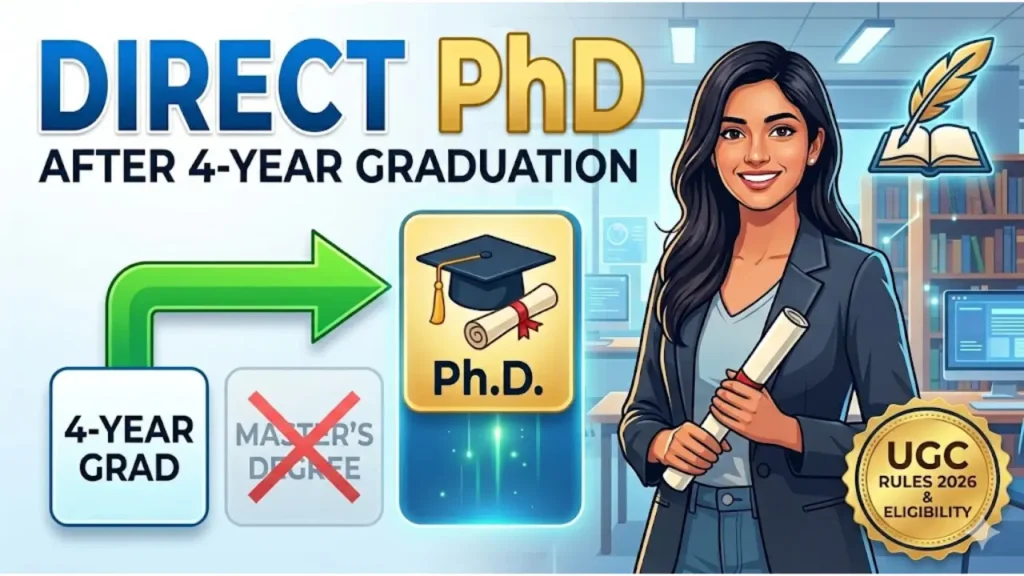
In our experience guiding students through higher education admissions, one of the most common points of confusion right now surrounds the new UGC regulations. If you are currently completing a B.Tech or a 4-year B.A./B.Sc. Honors degree, you are likely wondering: Do I still need to spend two full years on a Master’s degree before starting my research journey?
The traditional route was long and often discouraging for brilliant minds eager to dive straight into research. Fortunately, the landscape of Indian higher education has completely changed for the 2026 academic session, making the Direct PhD after 4-year graduation a reality.
Quick Answer: Can I do a Direct PhD without a Master’s Degree in 2026?
Yes, absolutely! Under the latest UGC regulations, candidates with a 4-year (8-semester) Bachelor’s degree are fully eligible for direct PhD admission without needing a Master’s degree. However, you must secure a minimum aggregate of 75% marks (or an equivalent grade) in your undergraduate program to qualify.
UGC New Rules for Direct PhD After 4-Year Graduation 2026
The University Grants Commission (UGC) has officially revamped the minimum standards and procedures for the award of PhD degrees. This is a massive shift aimed at aligning India’s education system with global standards and promoting early research opportunities.
Previously, a Master’s degree was the strict baseline for any doctoral program. Now, if you are pursuing a 4-year undergraduate program, you can bypass the postgraduate requirement entirely. This rule seamlessly applies to B.Tech, B.E., and the newly structured 4-year multidisciplinary Bachelor’s degrees.
This crucial rule change means you can directly appear for national-level entrance exams in your final year of graduation. You are now eligible to sit for exams like the UGC NET, CSIR NET, or GATE without ever enrolling in a PG course.
If you secure a qualifying rank, you become eligible for both the Junior Research Fellowship (JRF) and direct PhD admission at top universities across India. These UGC new rules for PhD 2026 are specifically designed to catch and fund research talent as early as possible.
It is very important to remember that a standard 3-year bachelor’s degree (like a traditional B.A., B.Com, or B.Sc.) will not qualify for this direct route. A Master’s degree is still mandatory if your graduation was completed in three years.
Eligibility Criteria: Who Can Apply for Direct PhD in 2026?
To take advantage of this new UGC regulation, you must meet specific academic requirements. The rules are strict regarding the duration of your undergraduate degree and your overall academic performance.
The primary requirement is that your Bachelor’s degree must be a 4-year program comprising 8 semesters. This includes professional degrees like B.Tech, B.E., B.Pharm, and the newly introduced 4-year B.A. or B.Sc. Research/Honors programs.
Secondly, you need a strong academic record. General category candidates must secure a minimum aggregate of 75% marks or its equivalent grade throughout their 4-year degree to be eligible for the direct PhD route.
[Note] Relaxation for Reserved Categories
A relaxation of 5% marks (or its equivalent grade) is officially provided for candidates belonging to SC, ST, OBC (Non-Creamy Layer), Differently-Abled, and Economically Weaker Sections (EWS). If you fall into these categories, you need a minimum of 70% marks to apply.
Comparison: 3-Year vs. 4-Year Bachelor’s Degree Rules
Many students are still confused about how the traditional 3-year degrees stack up against the new 4-year format. Here is a clear breakdown to resolve any doubts immediately:
| Degree Type | Duration | Master’s Degree Required? | PhD Eligibility |
|---|---|---|---|
| Traditional B.A. / B.Sc. / B.Com | 3 Years (6 Semesters) | Yes (Mandatory) | Only after completing a 2-year Master’s. |
| B.Tech / B.E. / 4-Year Honors | 4 Years (8 Semesters) | No | Directly Eligible (with 75% marks). |
How to Apply: The Direct PhD Admission Process 2026
Knowing the rules is only half the battle. In our experience guiding successful PhD candidates, the application execution is where most students make mistakes. Since you are bypassing a Master’s degree, universities will heavily evaluate your research aptitude through entrance exams and interviews.
Here is the step-by-step roadmap we recommend for securing a direct PhD seat in 2026:
Step 1: Crack a National-Level Entrance Exam
While having 75% marks makes you eligible, top institutes almost always shortlist candidates based on national exam scores. You must appear for exams like UGC NET, GATE, or CSIR NET during your final year.
For science and engineering students, staying updated on exam dates is crucial. You can find the CSIR NET 2026 complete details on our dedicated tracker page to ensure you don’t miss the application window.
Step 2: Track Institute-Specific Notifications
Different IITs, NITs, and Central Universities release their PhD application forms at different times (usually for Autumn and Spring semesters). You need to proactively check their official portals.
To make this easier, we regularly update our database. You can check upcoming PhD admission deadlines here to plan your applications well in advance.
Step 3: The Interview and Research Proposal
If your application is shortlisted based on your entrance score and B.Tech/4-Year degree marks, you will be called for an interview. This is the deciding factor. The interview panel will expect a clear, well-thought-out research proposal.
[Pro Tip] We Recommend Contacting Supervisors
Do not wait for the interview to meet your potential guide. Browse the university faculty profiles, read their recent publications, and send them a professional email expressing your interest in their research area before you apply. This drastically increases your chances of selection.
[Safety Warning] Fellowship & Stipend Rules
While direct PhD without NET is possible at some autonomous institutes via their own entrance tests (RET), securing funding is harder. We strongly advise clearing UGC/CSIR JRF. Without a national fellowship, Institute Stipends (usually ₹31,000 to ₹37,000) are highly competitive and not guaranteed for every direct PhD scholar.
Top Institutes Offering Direct PhD After B.Tech/Graduation
With the implementation of the new regulations, almost all premier institutions in India are updating their admission portals. If you meet the 75% marks criteria, you should actively target these universities:
- IITs and NITs: Indian Institutes of Technology (IITs) have historically offered direct PhDs to exceptional B.Tech students. Now, with the new rules, the process is heavily standardized across all NITs as well.
- Central Universities: Top-tier universities like JNU, BHU, and Delhi University are aligning their RET (Research Entrance Tests) to accommodate 4-year graduates. You can verify the overarching framework via the Official UGC Guidelines for Higher Education.
- IISERs and IISc: The Indian Institutes of Science Education and Research (IISERs) actively scout for young talent directly from 4-year BS-MS or B.Tech programs.
Remember, getting admission requires clearing a centralized exam in most cases. Always keep an eye on the National Testing Agency (NTA) Official Portal for upcoming UGC NET and CSIR NET exam schedules.
Frequently Asked Questions (FAQs)
1. Is a Master’s degree mandatory for a PhD in 2026?
No, it is no longer mandatory if you have completed a 4-year (8-semester) Bachelor’s degree with a minimum of 75% aggregate marks. If you have a traditional 3-year degree, a Master’s is still required.
2. Can I apply for UGC NET directly after a 4-year B.Tech?
Yes, under the new 2026 UGC regulations, candidates in their final year of a 4-year undergraduate program can appear for UGC NET and CSIR NET for both JRF and PhD admission.
3. What is the minimum CGPA required for direct PhD admission?
General category candidates require 75% marks or its equivalent CGPA. There is a 5% relaxation (making it 70%) for SC/ST/OBC/EWS and PwD candidates.
4. Are 3-year degree holders eligible for direct PhD?
No, graduates with a 3-year degree (like a standard B.A., B.Sc., or B.Com) must complete a 2-year Master’s program before applying for a PhD.

Shyam Giri is the Founder and Lead Editor at ResearchPhD.in. With a deep understanding of the Indian higher education landscape, Shyam specializes in decoding complex PhD admission processes, UGC NET strategies, and academic career planning. His mission is to empower students with authentic, research-backed information to help them secure their seats in top universities.